If you’re getting quotes to move a travel trailer, you’ve probably noticed transporters ask early on: “Is it a bumper pull or a fifth wheel?” It’s not a throwaway question. The hitch type changes the equipment required, the skill involved, and in some cases, the price.
Here’s what actually differs between the two — and why it matters who’s towing your RV.
The Core Difference: Where the Weight Sits
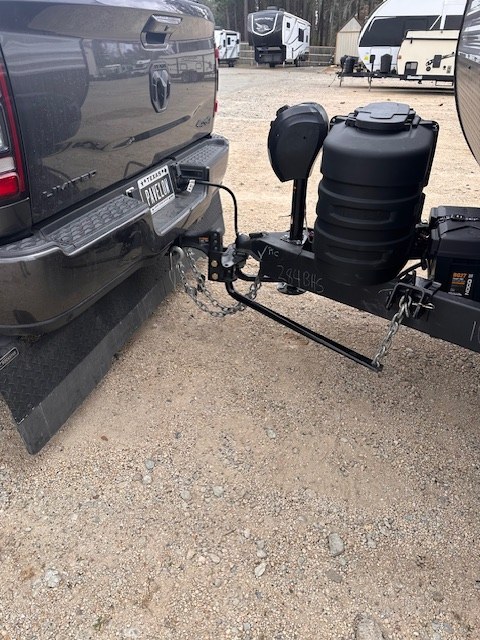
A bumper pull (also called a travel trailer or conventional trailer) connects to a ball hitch mounted on or behind the tow vehicle’s rear bumper. The trailer’s tongue weight sits behind the rear axle, which means more leverage on the tow vehicle and more potential for sway at highway speed.
A fifth wheel connects via a kingpin that drops into a hitch mounted in the bed of the tow vehicle, directly over or just ahead of the rear axle. This puts the pin weight over the axle instead of behind it — which is why fifth wheels tow noticeably more stable, even though they’re often heavier and taller overall.
That structural difference is the root of almost everything else on this list.
Equipment Requirements Differ
Bumper pull transport typically requires:
- A weight-rated ball hitch matched to the trailer’s tongue weight
- A weight distribution system on most trailers over roughly 5,000 lbs, to level the tow vehicle and reduce sway
- A sway control device, especially for lighter tow vehicles or longer trailers
- A properly calibrated electric brake controller
Fifth wheel transport requires:
- A fifth wheel hitch rated for the trailer’s pin weight, properly installed and torqued in the bed of the tow vehicle
- No weight distribution system needed — the hitch design handles weight transfer
- A brake controller, same as bumper pull
- More bed clearance and cab clearance checks, especially on shorter-bed trucks, to avoid the trailer contacting the cab during sharp turns
Gooseneck transport is a third category worth knowing about. A gooseneck trailer connects via a ball-and-coupler in the bed of the tow vehicle — similar in position to a fifth wheel but completely different in hardware. A fifth wheel hitch won’t accept a gooseneck coupler, and vice versa. Like fifth wheels, goosenecks place the hitch weight over the rear axle, which makes them stable under heavy loads. They’re common for horse trailers, large equipment haulers, and some toy haulers. If you have a gooseneck, confirm your transporter has a gooseneck ball setup in addition to a properly rated bed hitch — it’s a separate piece of equipment from a fifth wheel hitch.
A transporter who doesn’t have the right hitch simply can’t take the job — there’s no improvising around it. Bumper pull setups have more variation in how they’re rigged, which means more room for a transporter to get it wrong if they’re inexperienced.
Does It Affect the Price?
Sometimes — but not always for the reason people assume.
Price differences between bumper pull and fifth wheel jobs usually come down to weight class, not hitch type directly. At Mission Ready Transport, we price in two tiers:
- Under 10,000 lbs GVWR — the base rate tier most light-to-mid bumper pull travel trailers fall into
- 10,000 lbs GVWR and above — where most fifth wheels and larger toy haulers land
So a heavy bumper pull toy hauler and a heavy fifth wheel in the same weight class will price the same. A light bumper pull travel trailer under 10,000 lbs will price lower than either — not because of the hitch, but because of the weight.
Where hitch type can matter independently of weight: if a transporter doesn’t normally run fifth wheels and has to rent or install a hitch for your job, that cost may get passed along. That’s not a factor with a carrier who already runs fifth wheel equipment as standard.
Why the Driver’s Experience Matters More for Fifth Wheels
Fifth wheels tow more stable in a straight line, but they’re less forgiving in tight spaces — backing into a storage lot, navigating a campground loop, or maneuvering around a dealership lot all require more practice with the pivot point being over the axle instead of behind the vehicle.
Bumper pulls are more prone to sway at speed, particularly in crosswinds or when passed by semis, which means proper weight distribution and sway control setup isn’t optional — it’s the difference between a stable tow and a white-knuckle one.
Either way, the equipment has to match the trailer, and the driver has to know how to use it. This is exactly why a pre-trip inspection matters regardless of hitch type — verifying hitch engagement, safety chains, breakaway switch, tire pressure, and lug nut torque before the rig ever leaves the driveway.
What This Means When You’re Getting Quotes
When you submit a transport request, give an accurate hitch type and an accurate GVWR. GVWR is the manufacturer’s maximum rated weight — it’s stamped on the VIN sticker inside the door frame and sets the ceiling for what the trailer’s axles, suspension, and tires are designed to carry. It’s not the same as what the trailer actually weighs loaded (that’s GVW or scale weight). Both pieces matter:
- Hitch type tells the transporter whether their equipment is compatible
- Weight class determines the pricing tier
A transporter who doesn’t ask about hitch type before quoting is either guessing or assuming — neither is a great sign.
Bottom Line
Hitch type determines whether a transporter can take your job and what equipment they need. Weight class is what mostly determines price. The two are related but not the same thing — and a transporter who understands both is one who’s actually done this before.
We run both bumper pull and fifth wheel setups regularly, including our own personal 42’ fifth wheel, so we know what each one needs before we ever hook up.
Mission Ready RV Transport
Licensed carrier, USDOT 4552953 • MC 1808432. Veteran-owned, RVTAA Registered. Fully itemized quotes, no hidden fees. Serving Texas and the lower 48 states.
Questions before you fill out a form? Call or text us directly: (512) 593-1673
Get Your Free Transport Quote